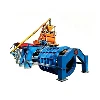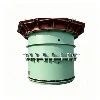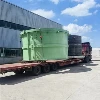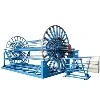
The suspended roller forming process offers specific advantages while also presenting certain limitations.
The suspended roller process is characterized by high production efficiency and relatively low costs; it features a short production cycle, a straightforward process, and easily controllable quality. Industry data indicates that this process holds a dominant market share in the production of prestressed concrete pipes and concrete drainage pipes, with a single machine capable of an annual output of 8,000 to 15,000 pipes. By utilizing the combined effects of roller pressure and centrifugal force, the process ensures a uniform concrete structure and high density within the pipe wall, resulting in superior concrete strength and high resistance to external pressure. The operational workflow is relatively simple, allowing for immediate demolding or rapid demolding and curing, with an average production rate of several pipe sections per hour. Because the process employs dry-stiff concrete, no excess cement slurry (waste) is generated; furthermore, noise levels during forming are lower than those of the centrifugal process, resulting in a cleaner operating environment. The finished pipes feature smooth inner walls and an aesthetically pleasing appearance.
However, the suspended roller process demands a high level of operational skill; factors such as feeding uniformity and rotational speed control directly impact pipe quality-for instance, uneven feeding can cause the pipe mold to bounce. Precisely controlling pipe wall thickness is difficult, and unevenness can occur. Additionally, the process requires a large number of molds (steel molds) with strict requirements for concentricity and inner-wall smoothness, leading to higher maintenance costs. When producing small-diameter pipes, wall thickness often needs to be increased to meet impermeability standards, resulting in higher material consumption. Under high-speed, heavy-load conditions, traditional suspended roller machines may suffer from insufficient compaction force and mold oscillation, potentially causing reinforcement cage displacement or poor forming quality at the pipe ends. Moreover, the equipment operates in a harsh environment, requiring regular maintenance of critical components-such as greasing the main shaft bearings every 500 hours-to prevent failures caused by dust and high temperatures.
Jul 20, 2026
Leave a message
Advantages And Disadvantages Of Suspended Roller Concrete Pipe Machines
Previous
No InformationSend Inquiry