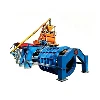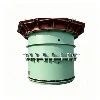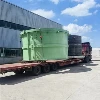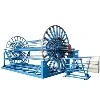
This equipment can produce pipes with a wide range of inner diameters-typically from Φ300mm to Φ2400mm (with some models reaching Φ3000mm)-and lengths usually ranging from 1000mm to 5000mm. Motor power generally falls between 15 kW and 75 kW. The roller shaft features stepless speed regulation (0–500 rpm), and the ratio of the roller shaft's outer diameter to the pipe's inner diameter ranges from 1:3 to 1:5.
Various series and models are available, including the XG series (e.g., XG300-600*2m), ZHG series (e.g., ZHG30-80, ZHG80-135), and GP series (models GP60, GP100, GP150, GP200, and GP240). The production ranges for the GP series models are: GP60 (Φ300–Φ600mm), GP100 (Φ500–Φ1000mm), GP150 (Φ800–Φ1500mm), GP200 (Φ1350–Φ2000mm), and GP240 (Φ1650–Φ2400mm), with nominal lengths typically between 2000mm and 4000mm.
Production efficiency varies by model and pipe diameter, averaging one pipe every 10 minutes or 6–8 pipes per hour. Based on a pipe length of 2000mm, the output per shift is approximately 15–60 pipes. Industry data indicates that a single suspended roller pipe machine can achieve an annual capacity of 8,000–15,000 pipes (Φ300–Φ2000mm).
Suspended roller pipe machines must comply with industry standards such as JC/T 697, "Suspended Roller Forming Machine for Reinforced Concrete Pipes." The suspended roller process is widely used in the production of concrete drainage pipes, accounting for nearly 65% to over 70% of total production volume.
Jul 16, 2026
Leave a message
Technical Parameters And Models Of Suspended Roller Concrete Pipe Machines
Send Inquiry