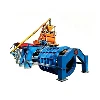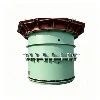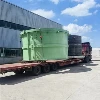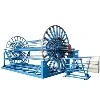
The suspended roller machine features a compact design and consists primarily of six components: the machine frame, gantry frame, suspended roller shaft, main motor, traveling feeding trolley, and feeding trough.
Its core components are the suspended roller shaft and the steel mold; reinforced concrete pipes are formed through the pressure and centrifugal force generated by the rotation of the mold and the shaft.
The feeder is used to evenly convey the concrete mixture into the mold; feeding via a mechanical feeder is recommended whenever the mold's internal clearance permits. The feeder must operate with smooth travel and uniform belt speed, ensuring that the material is fully supplied within two to three round trips.
Certain models (such as dual-roller suspended roller pipe machines) utilize a dual-roller configuration to provide greater compaction force and to mitigate issues such as mold oscillation and reinforcement cage displacement.
To protect the bearing shells from dust damage in harsh operating environments, a labyrinth seal structure is installed between the flanges at both ends of the suspended roller shaft and the mandrel, while at least one sealing ring is positioned between the flange and the connecting sleeve.
Regarding structural maintenance, adjustment bolts are used to ensure coaxiality between the suspended roller shaft and the drive shaft; additionally, areas of the suspended roller shaft ends that contact the pipe mold retaining rings require build-up welding and machining if wear occurs.
Jul 15, 2026
Leave a message
Structural Composition Of The Suspended Roller Concrete Pipe Machine
Send Inquiry