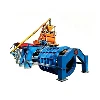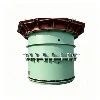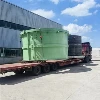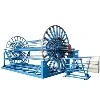
The suspended roller pipe-making process utilizes a machine driven by an electric motor. The suspended roller shaft and the steel mold-mounted over the roller-rotate together due to friction. Centrifugal force generated by the rotating mold causes the concrete mixture fed into it to adhere evenly to the inner wall, forming a tubular shape. Once the concrete thickness exceeds the level of the mold opening, the suspended roller shaft directly and repeatedly compresses the concrete against the wall, rapidly achieving the required density and a smooth inner surface.
Equipment designed for this process typically consists of a machine frame, a gantry, a suspended roller shaft, a main motor, a mobile feeding carriage, and a feed trough.
The operation begins by hoisting the pipe mold onto the suspended roller shaft and locking the gantry in place. The machine is then started, causing the mold to rotate with the shaft. Concrete mixture is fed evenly into the rotating mold-either mechanically or manually-and centrifugal force distributes it along the inner wall to form a tube. As the concrete layer builds up beyond the height of the mold's retaining ring, the mold is lifted off the suspended roller shaft by the concrete layer itself; at this stage, the rotating shaft directly and repeatedly compresses the concrete against the wall to ensure compaction. Once the rolling process is complete, the machine is stopped, and the mold is removed from the shaft for curing.
Jul 14, 2026
Leave a message
Working Principle Of The Suspended Roller Concrete Pipe Machine
Send Inquiry